
Industrial Tunnel Ovens
The Henry Group manufactures bakery tunnel ovens that are direct gas-fired and indirect gas-fired, designed for baking a vast variety of products.
Direct Gas Fired Tunnel Oven
These tunnel ovens for commercial bakeries are designed for baking a vast variety of products in pans or directly on the hearth. Air turbulence provides a uniform bake with strong product side walls and shorter bake time. Multiple thermocouple sensors determine bake chamber temperature and provide zoned temperature control for complete flexibility. Individually controlled burners are located above and below the hearth for even heat distribution. The mesh hearth allows for air circulation and uniform pattern on the bottom of products.
Indirect Gas Fired Tunnel Oven
The Henry Group's indirect gas, propane, or oil-fired tunnel ovens are designed for baking products both in pans and directly on the hearth. Natural gas or oil burners fire into a combustion chamber that supplies the radiant heat system within the baking chamber. This keeps combustion by-products outside the baking chamber allowing products to bake in the heated ambient air. The mesh hearth allows complete air circulation and uniform pattern on the bottom of products. THG provides full lateral heat adjustments every ten feet for maximum bake control in the upper and lower zones. Steam zones are available as optional upgrades.
- Flash Heat is the build-up of heat in the oven that is left in the empty Bake Chamber and can over bake the leading and trailing groups of production runs. THG's turbulence systems create a continuous wiping action around the product to aid in faster bake times, reduced baking temperatures, and overall reduced energy consumption while providing a uniform bake.
- 15'-6" Bake Chamber by THG is the widest in the Industry for additional throughput without compromising on a quality bake. All of our innovative designs work seamlessly to provide maximum output and a highly consistent bake.
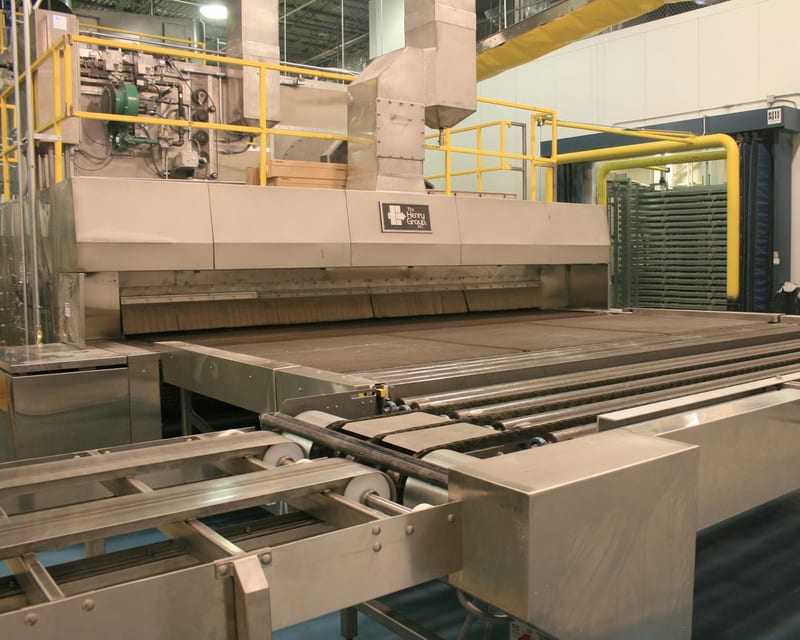
- Roller Bed Chevrons come standard on our mesh tunnel ovens for commercial bakeries, this technology was pioneered by THG for reduced friction on the carrying surface. Also available are our Plate or Grid Hearth drive systems.
- Integrated Oxidizers means truly integrated structurally, functionally, and electrically for maximum efficiency and control. Our e4 TurboTherm technology is available on our Hybrid DGF/IDF ovens.
Specifications
Each tunnel oven is engineered for the product, bake profile and floor space of the line it serves. These are the main choices; your quote sets them for your project.
- Hearth width: from one meter up to the 15'-6" bake chamber
- Oven length: set by the bake time and output the line needs; indirect-fired ovens are built from 10-foot modules
- Heat source: direct gas-fired, with ribbon burners above and below the hearth; indirect-fired by natural gas, propane or oil through a separate combustion chamber; or hybrid direct/indirect-fired with e4 TurboTherm technology
- Temperature zones: set during engineering; each direct-fired zone has separate top and bottom heat adjustment, and indirect-fired ovens have top, bottom and side-to-side dampers in every 10-foot module
- Bake time: set by the main drive speed and saved in product recipes; direct-fired ovens have a standard bake-time range of about 6 to 60 minutes
- Hearth: sprocket-driven open grid belt for panned products, friction-driven mesh belt for pans or hearth goods, or plate or grid hearth drive systems
- Product carriers: pans, foil or cardboard trays and tins (with multi-row servo loaders and unloaders), or product baked directly on the belt
- Controls: PLC-based PID temperature control with multiple thermocouples in each zone, an operator interface with product recipes and alarm history, and burner safety that follows NFPA 86
- Steam: optional steam section at the oven entrance
Construction
- Steel baking chamber with expansion joints, carried on a heavy-duty structural steel frame
- Explosion relief built into the oven ceiling
- Mineral wool insulation rated to 1,000°F in the sidewalls, roof and floor
- Stainless steel finish sheets, with stainless kick plates over exposed base channels
- Lighted viewing windows, burner observation ports, and insulated access openings above and below the hearth on both sides
- Main drive and tail shafts turn in roller bearings outside the baking chamber, giving fixed load-on and discharge points
Hearth Belts and Drives
- Sprocket-driven open grid belt for panned products. Positive engagement means no tracking system is needed, and the open grid allows maximum airflow.
- Friction-driven mesh belt on a roller bed, for products in pans or hearth goods baked directly on the belt
- Automatic optical belt tracking for friction-driven belts, with manual override
- Pneumatic belt take-up that holds tension from room temperature to bake temperature, with a limit sensor that alerts the operator
- Inverter-driven main drive, with bake time saved in product recipes
Heat and Zone Control
On direct gas-fired ovens, individually controlled ribbon burners sit above and below the hearth, and each temperature zone has separate top and bottom heat adjustment. On indirect gas-fired ovens, a burner in each tower fires into a stainless steel-lined combustion chamber, and a recirculating blower moves the heated air through ducts and radiators. Dampers in each 10-foot module adjust top-to-bottom and side-to-side heat.
The turbulence system recirculates bake-chamber air through tubes above and below the product, independently of the main heating system, at up to 500°F. It improves heat transfer to the top and sidewalls of the product and gives more control over the baking profile.
Steam Sections
Optional steam sections at the oven entrance use 304 stainless steel pipe-within-a-pipe headers that keep condensate off the product and can be rotated to aim the steam. Curtains at each end hold the steam in, and full-width stainless cleanout drawers sit under the hearth. Steam helps product expansion, moisture retention, crust development and surface finish.
Controls and Burner Safety
- PLC-based PID temperature control with multiple thermocouples in each zone
- Operator interface for bake time, temperature, turbulence and loader settings, with product recipes, alarm history and diagnostics
- Burner safety systems that follow NFPA 86, including proven airflow, high and low gas pressure switches, a high-temperature limit, automatic purge and automatic gas safety shutoff valves
- Burners drop to low fire if the oven drive stops
- Separate E-stops for the burners or the whole oven, and a single lockout point at the main control panel
- Control panels built to the National Electrical Code, with UL testing at THG before shipment where local codes require it
Options
- Steam sections
- Integrated catalytic oxidizer that removes ethanol from bake-chamber air and returns the heat to the first zone
- Powered hearth cleaning brush with slide-out crumb pans
- Remote operator interface
- Oven stacks
- Matched loaders, unloaders, groupers and conveyors
Project Example: Rich Products
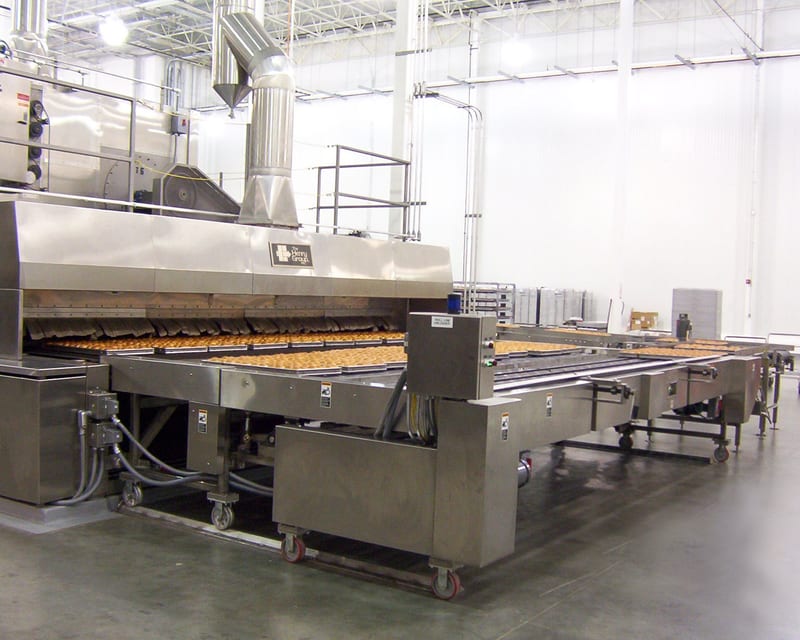
THG supplied a complete baking system for Rich Products, built around a 100 ft tunnel oven. Along with the oven, the system includes an overhead proofing system, conveyors and support equipment.
Installation, Service and Parts
Installation is available as a separate service. THG crews handle millwright and mechanical installation, start-up assistance and relocations, with licensed electrical work by our partner; see equipment installation.
After start-up, oven services cover annual OSHA and mechanical inspections and repairs, and oven rebuilds, upgrades and repairs cover rebuilds, extensions and retrofits of existing ovens from THG and other manufacturers. THG makes replacement parts such as burner assemblies, oven chain and sprockets, and hearth plates. To price an oven, request a tunnel oven quote.
Common questions
What is a tunnel oven best for?
Continuous, high-volume baking. Product rides a moving hearth through the bake chamber, so every pan or piece gets the same bake profile, and bake time is set by the belt speed. THG tunnel ovens bake products in pans or directly on the hearth. Direct gas-fired ovens put ribbon burners above and below the hearth; indirect-fired ovens keep combustion outside the bake chamber, so product bakes in heated air.
How does a tunnel oven fit into a complete line?
It sits between proofing and cooling. A grouper gathers proofed pans into groups, and a loader pushes each group onto the hearth. At the discharge, an unloader moves pans onto a cross conveyor toward depanning, cooling and packaging. THG builds the loaders and unloaders, groupers and conveyors to match the oven, interlocks them with its controls, and can supply the complete line.
Can the oven be sized to our plant and product?
Yes. Width, length, number of zones, heating type, hearth and options such as steam and turbulence are set during engineering, based on the product, the bake profile it needs and the space available. The Specifications section above lists the main choices.
Does THG install the oven?
Installation is available as a separate service. THG started in 1976 as a bakery equipment installer, and its crews handle millwright and mechanical installation, start-up assistance and relocations, with licensed electrical work by our partner. See equipment installation.
Can you rebuild or retrofit an existing tunnel oven?
Yes. THG rebuilds, upgrades, extends and repairs tunnel ovens from THG and many other manufacturers. Retrofits include turbulence systems, burner and drive safety, DSI (direct spark ignition) upgrades, and new loaders and unloaders for existing ovens. See oven rebuilds, upgrades and repairs, oven services and replacement parts.
What is the lead time for a new tunnel oven?
Lead time depends on the oven's size and options and on the rest of the line. Request a tunnel oven quote for a schedule for your project.
Equipment in production
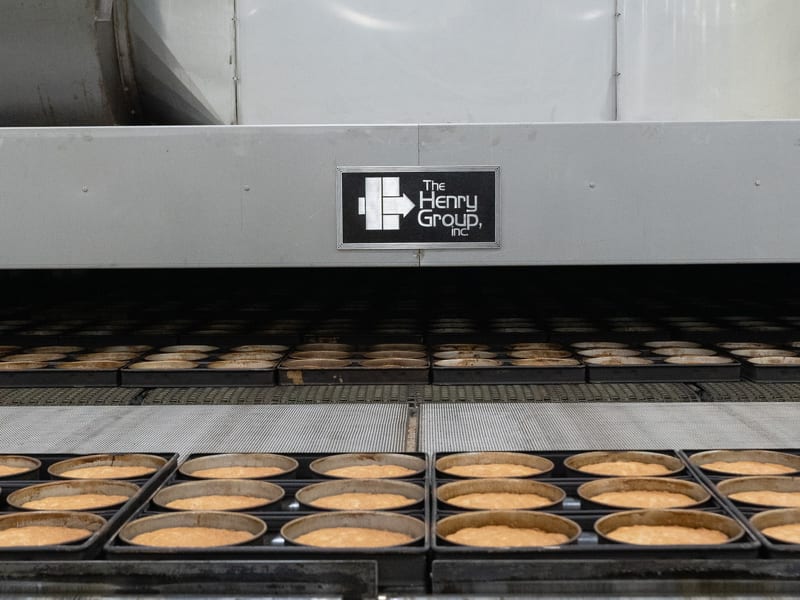
A THG tunnel oven in production
Products leaving a THG tunnel oven.
More bakery equipment videos →Talk with THG about your equipment.
Share your product, the process and the equipment you need to connect.